

Most institutions treat “digital transformation” as a procurement decision: pick an ERP, roll it out, check the box. But an ERP and a digital campus platform solve two fundamentally different problems. One keeps records straight for auditors and regulators. The other decides whether a student’s day-to-day experience of the institution feels coherent or chaotic.
Confusing the two is why so many “digitised” campuses still feel exactly as bureaucratic as their paper-based predecessors, just faster.
QUICK SUMMARY
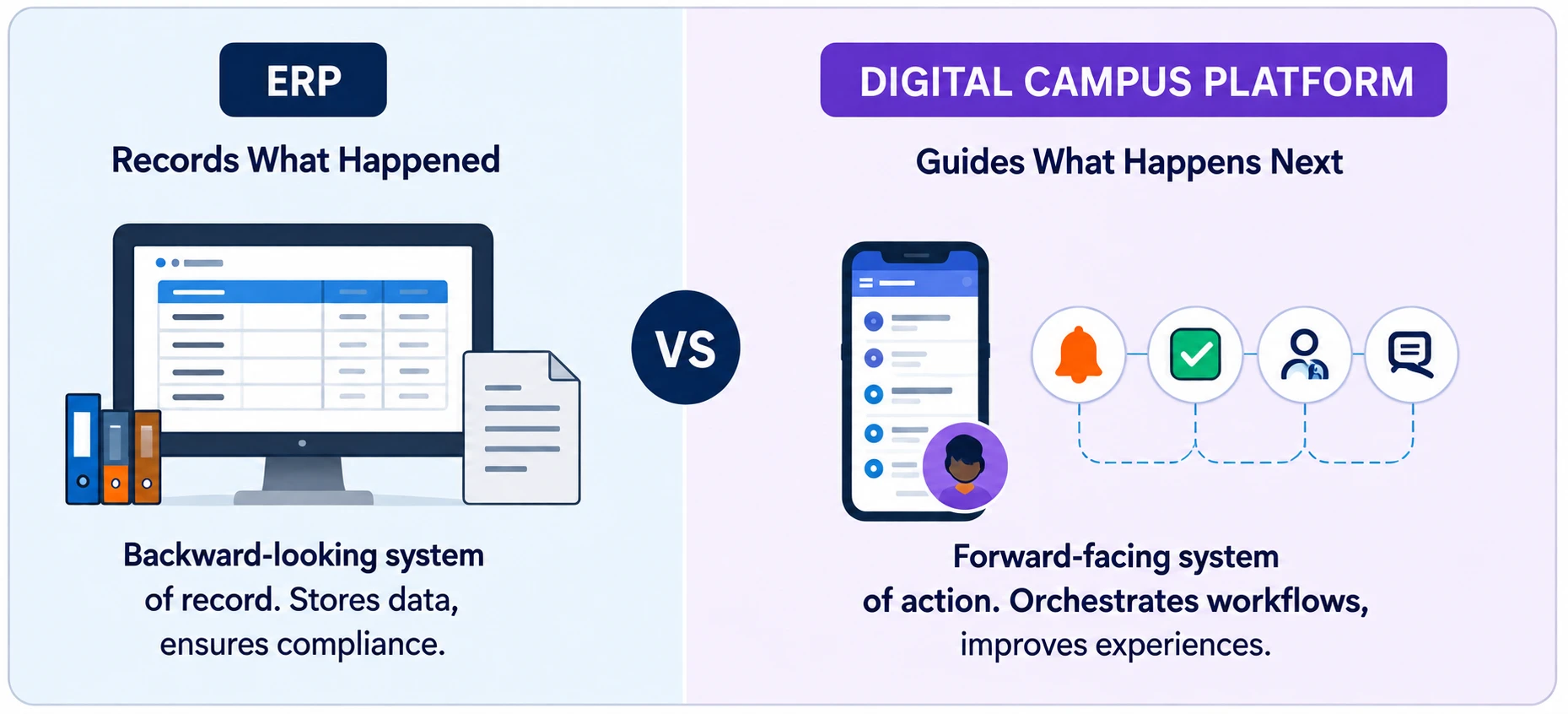
- ERPs are transaction systems, built to record what happened.
- A digital campus platform is a workflow system, built to guide what happens next.
- The gap shows up as siloed departments, students running in circles, and a widening mismatch between Amazon-grade expectations and form-and-signature-grade reality.
- The fix is sequencing, not more software: fix the process, get the record straight, then build engagement and intelligence on top.
The Core Distinction: Recording the Past vs. Running the Present
An ERP’s job, at its core, is to be an accurate historical ledger: fees paid, grades entered, credits awarded. That’s essential. But it’s backwards-looking by design.
A digital campus platform’s job is to be forward-facing: it doesn’t just store the fact that a student has a hold on their account; it makes sure the student knows, understands why, and can resolve it — in the moment, without a run-around.
As Jitu Mishra, Chief Administrative Officer at the Indian School of Business, frames it, the conversation shouldn’t even start with software:
“Let us not talk about the ERP or some software on it, but let us talk about the processes, information flows, platforms that shape every operational outcome in an educational institution.”
Jitu Mishra, Chief Administrative Officer, Indian School of Business
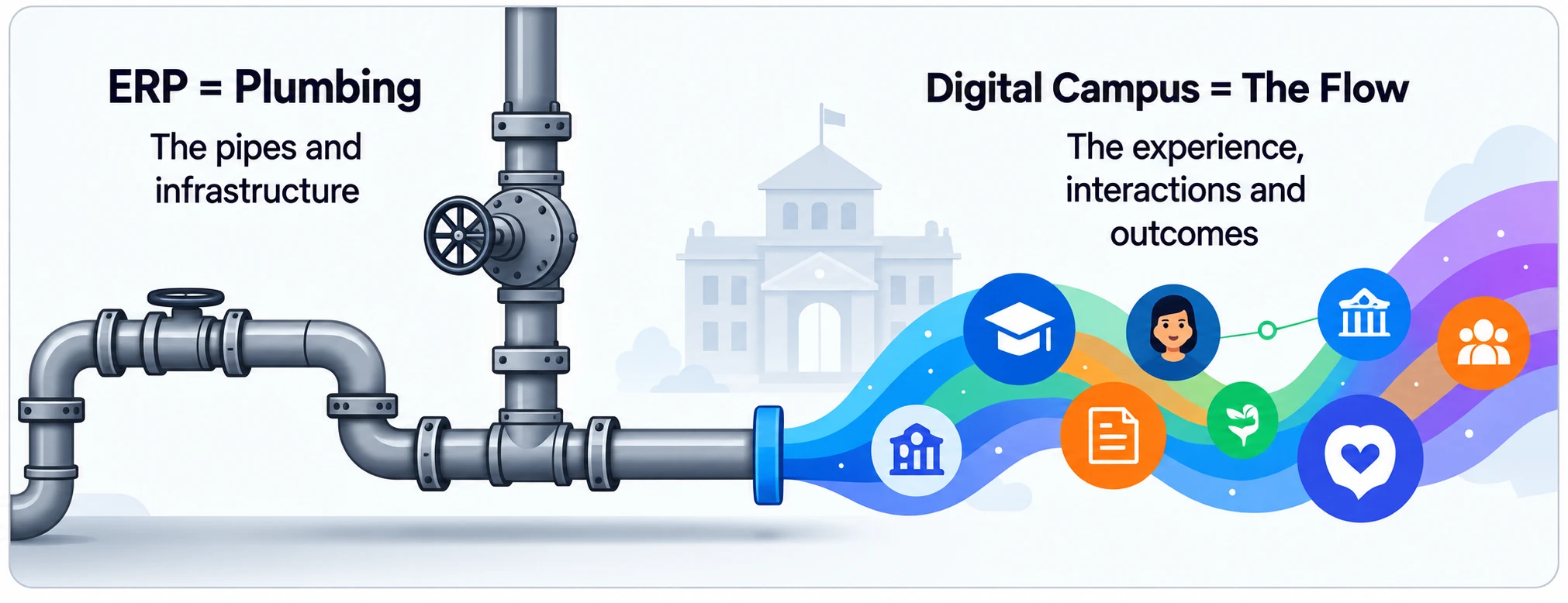
That’s the reframe worth holding onto: the ERP is plumbing. The digital campus is what flows through it, or doesn’t.
5 Ways ERPs Quietly Fall Short of a Digital Campus
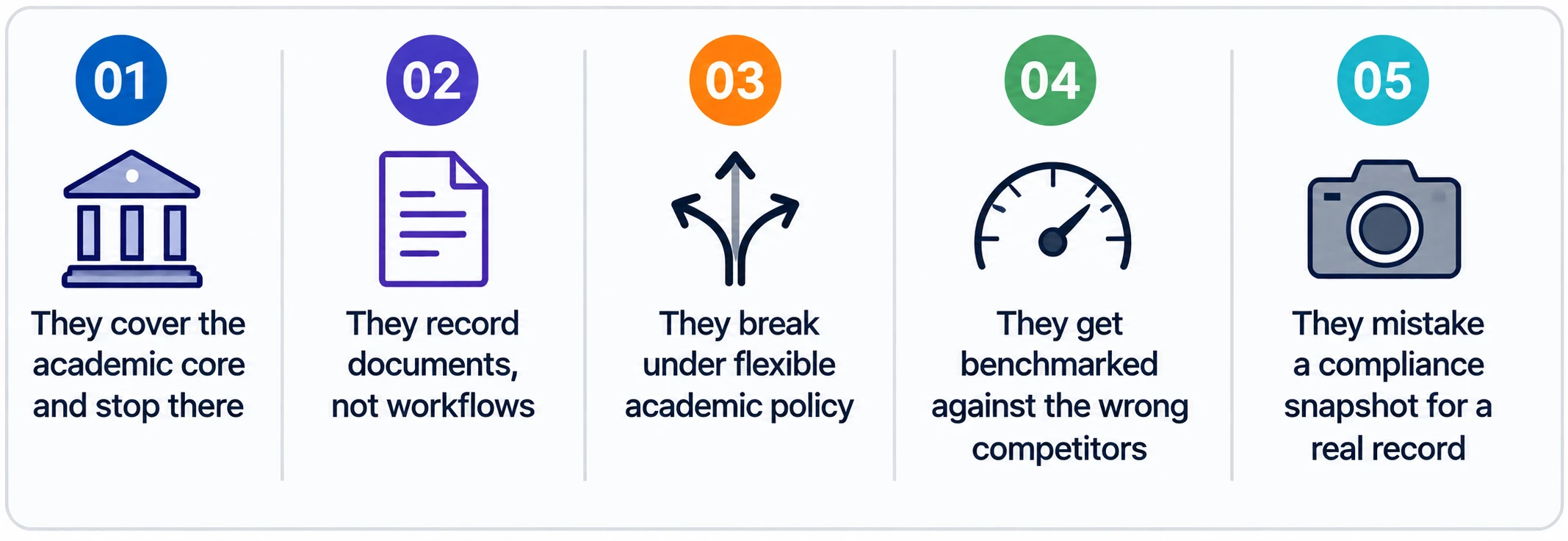
01They cover the academic core and stop there
Most ERP deployments were scoped around admissions, grades, and fees — and never grew past it. Housing, wellness, clubs, placements, and campus life at large are usually left to a patchwork of separate tools, or nothing at all. The result is a system that’s excellent at 40% of a student’s institutional life and invisible for the other 60%.
02They record documents, not workflows
A well-written Standard Operating Procedure describes an intention. Whether that intention becomes a lived experience depends entirely on whether the system acts on it — routes it, tracks it, nudges the right person at the right time — or just stores it as a file. Document-based systems tend to do the latter, which is precisely how a student ends up chasing three offices for one signature.
03They break under flexible academic policy
Modern academic models — credit-based mobility, multiple entry and exit points, cross-institutional transfers — assume a level of structural flexibility that rigid, table-based ERP architectures often can’t provide. Institutions that have tried to run these policies through a standard ERP have found the software itself becomes the bottleneck, not the policy.
04They get benchmarked against global competitors
Students don’t compare their college portal to other college portals. They compare it, consciously or not, to Amazon, Netflix, and Swiggy. A form that requires a physical queue, or a result that takes weeks to post, doesn’t register as “normal for a university.” It registers as the institution falling behind, full stop.
05They mistake a compliance snapshot for a real record
Updating grades once a semester to satisfy a regulatory requirement isn’t the same as maintaining a continuously accurate record of what’s actually happening. One is what Naveen Gupta of Reliance Jio calls “a photograph” — a point-in-time capture built for an audit. A genuine system of record is different in kind:
“System of record is basically it comes out of digital doing... your life cycle is a digital part. It is being recorded there... it is machine-written now, it is no more human-written.”
Naveen Gupta, Reliance Jio
That distinction: machine-written and continuous, versus human-updated and periodic, is really the whole ballgame.
The Missing Layer, Named Plainly: Engagement
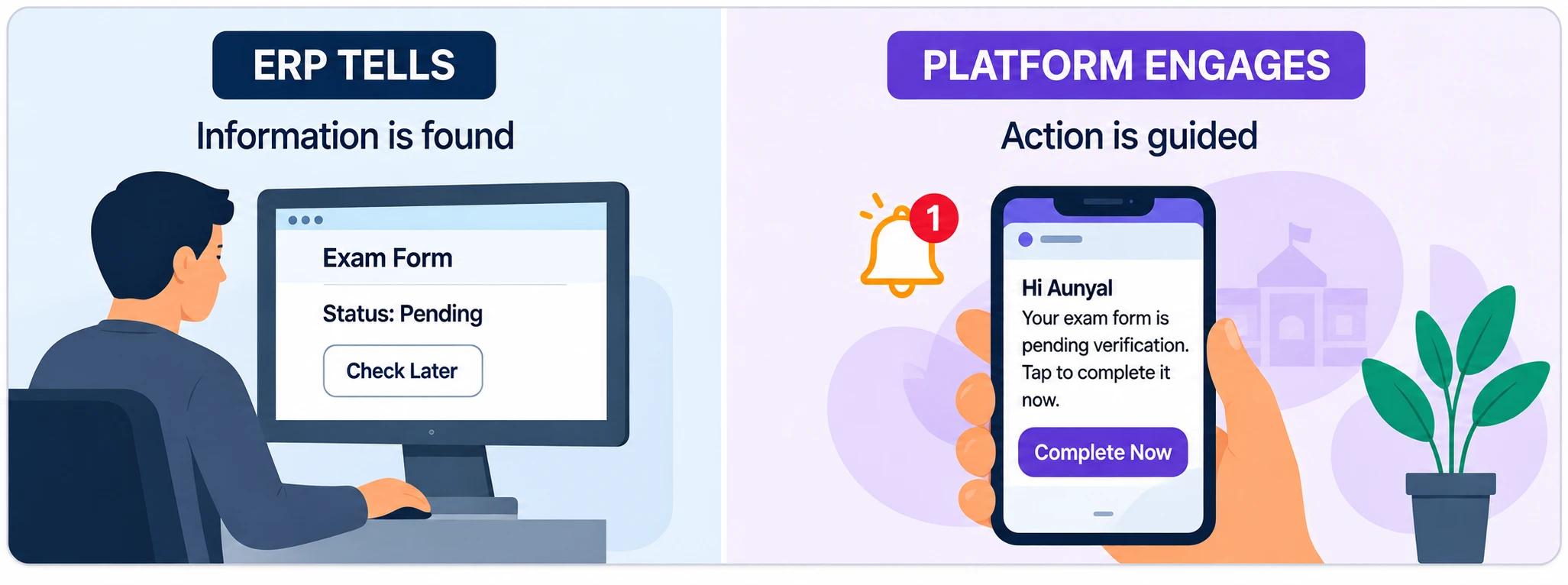
It’s worth pausing on what “engagement” actually means in practice, because it’s easy to nod along to the word without picturing what it changes. Shazil Ahmed, VP at Digii, draws the line with a simple test: an ERP digitizes records; a digital campus platform digitizes the experience built on top of those records.
“College ERP typically focuses on digitising the records — versus digital campus platform, when we talk about it, we are talking about not just digitising the records; it is also about digitising the experience for the stakeholders.”
Shazil Ahmed, VP, Digii
A digitized record tells the institution that a student’s fee is paid, or that an exam result exists, or that a grievance was logged. That’s useful — it’s what lets management make better decisions, because the data is finally available. But it’s still a one-way flow, institution-to-database. A digital campus platform closes the loop back to the student:
“When does it become a digital campus — where a student wants to make a payment through the app and get the receipt right there. The student wants to access some campus facility, he does it right from the app, books the venue. He has some grievance, he does it right through there. So the layer of engagement is what is missing in ERPs — that is why a digital campus should add the layer of engagement.”
Shazil Ahmed, VP, Digii
A concrete example: the mess hall test
Ahmed offers a small, telling illustration of the difference. A traditional ERP-run mess hall gives a student a token; they eat, transaction closed, no further data. A platform with an engagement layer changes what’s even knowable:
“If I'm saying you have to scan a QR code, I will measure which meal you have taken or not, that will give an understanding of how much wastage is happening, how the stakeholders are consuming the food.”
Shazil Ahmed, VP, Digii
Same physical activity, two completely different information outcomes. One system just clears a transaction. The other generates operational intelligence the institution didn’t have before — and couldn’t have gotten by digitising the record alone.
How to Actually Evaluate a Platform: 3 Questions, Then 3 Different Questions
A useful two-stage framework for institutional leaders: the questions to ask before investing, and a different set of questions to ask after a year of running the system.
Before you invest, ask:
- How much time is saved for each stakeholder group by doing this?
- How much physical, manual effort is removed from day-to-day processes?
- How much cost is cut as a result of these activities?
A year in, the questions shift:
- How much time is now spent resolving grievances, compared to before?
- What’s the net promoter score of students, faculty, and staff after the change?
- What’s actual expenditure today, versus what it used to be?
The shift matters: the first set justifies a purchase. The second set tells you whether the purchase actually worked. As Ahmed frames the progression: record, then engagement, then intelligence, it’s only after the engagement layer is in place that an institution can actually measure the excellence of what it built, rather than assume it.
Why This Actually Matters: Three Costs of Treating the ERP as the Finish Line
It costs students trust, not just time
Fragmentation doesn’t register to a student as an org-chart problem. Dr. Radhika Shrivastava, President of the Fortune Institute of International Business, puts it bluntly: being sent from office to office isn’t experienced as bureaucracy, it’s experienced as “you don’t care about me.” That’s a retention risk hiding inside what looks like an operational inefficiency.
It costs institutions a real transformation, disguised as a fake one
Buying and rolling out software isn’t the same as changing how an institution runs. Vignesh Murugesan of KPMG has observed this gap directly: heavy digital adoption across universities over the last decade, he notes, “has not led to any institutional transformation” — in many cases, it’s simply been treated as a procurement exercise. Gaurav Sharma of Indira University adds the missing piece: real transformation requires organizational change management, not just IT — “re-engineering, re-imagining… the whole people process,” with technology folded in, not bolted on.
It costs leadership the chance to fix the actual problem
The riskiest move institutions make is automating a process before fixing it. Gopi BR, IT Head at Rajalakshmi Engineering College, doesn’t soften this one:
“Automating a broken process doesn’t fix it — it scales it.”
Gopi BR, IT Head, Rajalakshmi Engineering College
Speed applied to a bad process just produces bad outcomes faster, at a larger scale, with a shinier interface.
The Right Sequence: Record → Engagement → Intelligence
If there’s one structural model worth adopting wholesale, it’s this three-stage progression, described by Dr. Ramakrishnan Raman, Vice-Chancellor of Symbiosis International:
- System of record — get the institution’s truth in one place, continuously accurate, not assembled in a scramble before an accreditation visit.
- System of engagement — once the record is trustworthy, redesign how students, faculty, and staff actually meet the institution and exchange information with it.
- System of intelligence — only now does AI have anything real to compound on.
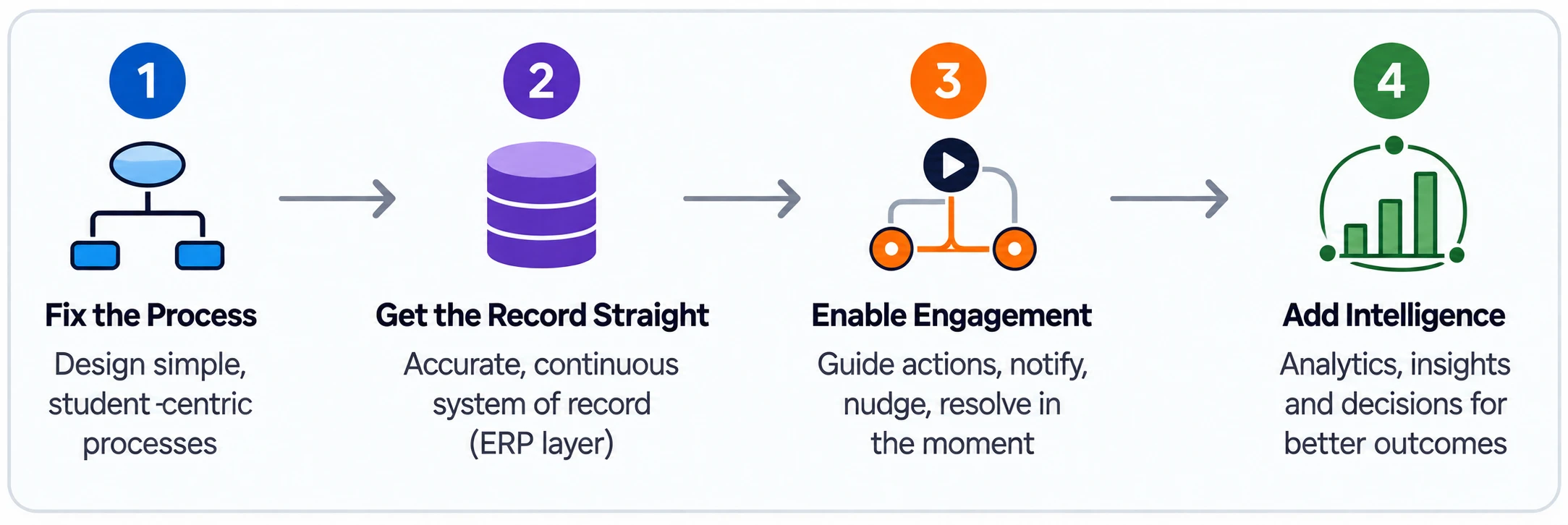
His warning is the part institutions tend to skip: “people want to take the third lens first.” Without a solid record and a working engagement layer underneath it, AI initiatives sit on top of unreliable data and disconnected processes — which means they inherit every flaw of the systems below them, just faster.
The practical implication, from Dr. Simon Mak of Universal AI University, is a useful closing rule of thumb for any institution about to start this work:
“Forget the digitization first. Let's get the process down. Make sure it's simplified. Now, let's talk about how do we digitize it.”
Dr. Simon Mak, Universal AI University
The Bottom Line
An ERP isn’t wrong to have. It’s incomplete on its own. It answers “what happened” with precision an institution genuinely needs for compliance and governance. But it was never built to answer “what should happen next, for this specific student, right now” — and that’s the question a digital campus platform exists to solve.
Treating the ERP as the endpoint of digital transformation, rather than the foundation for it, is how institutions end up with clean records and disengaged students — technically compliant, functionally disconnected.


